

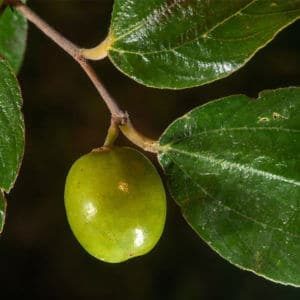
Uguressa is a species of flowering plant native to much of Africa and tropical and temperate parts of Asia. Fruit is eaten raw or made into jelly or jam. It can be fermented to make wine.
The tree is planted as a living fence; it was one of the species used for the Indian Inland Customs Line. The wood is used for firewood and small wooden tools such as plow handles.
Flower : The flowers are bright red and 3 cm (1.2 in) in diameter, with three to seven petals
Fruit : Red-purple in color, the pomegranate fruit husk has two parts: an outer, hard pericarp, and an inner, spongy mesocarp (white “albedo”), which comprises the fruit inner wall where arils attach.Membranes of the mesocarp are organized as nonsymmetrical chambers that contain seeds inside arils, which are embedded without attachment to the mesocarp. Containing juice, the arils are formed as a thin membrane derived from the epidermal cells of the seeds. The number of seeds in a pomegranate can vary from 200 to about 1,400
Culinary Uses : Pomegranate juice can be sweet or sour, but most fruits are moderate in taste, with sour notes from the acidic ellagitannins contained in the juice. Pomegranate juice has long been a popular drink in Europe and the Middle East, and is now widely distributed in the United States and Canada.
Grenadine syrup long ago consisted of thickened and sweetened pomegranate juice, now is usually a sales name for a syrup based on various berries, citric acid, and food coloring, mainly used in cocktail mixing. In Europe, Bols still manufactures grenadine syrup with pomegranate.Before tomatoes (a New World fruit) arrived in the Middle East, pomegranate juice, molasses, and vinegar were widely used in many Iranian foods, and are still found in traditional recipes such as fesenjān, a thick sauce made from pomegranate juice and ground walnuts, usually spooned over duck or other poultry and rice, and in ash-e anar (pomegranate soup).
Other Uses : The most abundant phytochemicals in pomegranate juice are polyphenols, including the hydrolyzable tannins called ellagitannins formed when ellagic acid and gallic acid binds with a carbohydrate to form pomegranate ellagitannins, also known as punicalagins.The red color of the juice is attributed to anthocyanins, such as delphinidin, cyanidin, and pelargonidin glycosides.Generally, an increase in juice pigmentation occurs during fruit ripening.The phenolic content of pomegranate juice is degraded by processing and pasteurization techniques.
Compared to the pulp, the inedible pomegranate peel contains as much as three times the total amount of polyphenols, including condensed tannins, catechins, gallo catechins and pro delphinidins. The higher phenolic content of the peel yields extracts for use in dietary supplements and food preservatives.
Height : 5 and 10 m (16 and 33 ft) tall
Leaves : P. granatum leaves are opposite or subopposite, glossy, narrow oblong, entire, 3–7 cm (1 1⁄4–2 3⁄4 in) long and 2 cm (3⁄4 in) broad
Related medicinal properties : In India’s ancient Ayurveda system of traditional medicine, the pomegranate is frequently described as an ingredient in remedies.
Pomegranate seed oil contains punicic acid (65.3%), palmitic acid (4.8%), stearic acid (2.3%), oleic acid (6.3%), and linoleic acid (6.6%).
Pomegranate ellagitannins are under preliminary research for their potential health benefits. In vitro and in vivo studies have shown that most of their observed effects are due to a group of metabolites called urolithins which result from the transformation of ellagitannins by the microbiota.


Reviews
There are no reviews yet.