
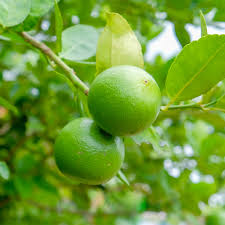
Lime is native to Southeast Asia. Its apparent path of introduction was through the Middle East to North Africa, then to Sicily and Andalucia and via Spanish explorers to the West Indies, including the Florida Keys. Henry Perrine is credited with introducing the Key lime to Florida.From the Caribbean, lime cultivation spread to tropical and subtropical North America, including Mexico, Florida, and later California.
The Key lime has given rise to several other lime varieties. The best known, the triploid progeny of a Key lime-lemon cross, is the Persian lime (Citrus × latifolia), the most widely produced lime, globally. Others are, like their parents, classed within C. aurantiifolia.
Flower : small, white
Fruit : small, globose to ovoid, greenish-yellow, the pericarp glandular dotted, very thin, juice very sour, seeds small.
Edible parts : Fruit
Ayurvedic usage : Skin diseases, Coughs, Dysentery, Dandruff
Height : 5 m (16 ft)
Leaves : small, mostly 5-7.5. Inflorescence short, 2-7- flowered, rarely 1-flowered, axillary
Related medicinal properties : Reduces aggravation of vata, pitta and kapha, Prevents heart, diseases, Appetizer, Cleanses skin, Rich in vitamin – C., Natural antiseptic, Purifies blood


Reviews
There are no reviews yet.